
In the Industry 4.0 and supply chain ecosystem, asset visibility has become an absolute performance requirement. Whether it’s managing inventory, optimizing production flows, or ensuring on-site security, location data is the fuel for operational efficiency. However, when choosing a tracking infrastructure, there is often confusion between two fundamental approaches: point-in-time identification and continuous tracking.
On the one hand, RFID (Radio Frequency Identification) has been the standard for mass traceability for decades. On the other hand,Wheere’snext-generation RTLS (Real-Time Location System) offers dynamic, uninterrupted tracking of movements.
This guide breaks down the key features of these two pillars of traceability to help you align your technology investments with your actual operational needs.
For more than twenty years, RFID (Radio Frequency Identification) technology has been the cornerstone of industrial traceability. Its success is based on a simple principle: the exchange of information over short or medium ranges between a chip (the tag) and a reader. In a digitization project, it is the go-to solution when the primary objective isautomatic identification and counting.
The key strength of RFID, particularly in its passive form, lies in its economies of scale. With tags costing only a few cents and requiring no batteries, it makes it possible to tag millions of items, bins, or components. For managing very high-volume inventories, where each asset does not need to be tracked individually at all times, RFID offers a very attractive return on investment.
One of RFID’s unique capabilities is its ability to identify hundreds of items simultaneously, without direct visual contact. A reader mounted on a forklift or above a conveyor belt can scan an entire pallet in a fraction of a second. This feature is essential for speeding up flash inventory counts or receiving checks in a warehouse.
RFID excels at verifying logistics stages through mandatory checkpoints (dock gates, workshop entrances). It acts as a digital barrier: the system confirms with near-total reliability that an item has left Zone A to enter Zone B. It is the tool of choice for shipping automation, ensuring that the right package is loaded onto the right truck at the right time.
In summary: RFID is the technology of the moment.
It provides a highly effective answer to the question: “Has this item passed through this stage?”
While RFID is defined by its ability to identify an asset at a specific location, the Wheere system was designed to provide uninterrupted spatial visibility. Here, the challenge is no longer simply to know “which” object has passed through, but to track precisely how it moves throughout an entire industrial or logistics site.
The key difference lies in the nature of the data generated. An RTLS system like Wheere’s generates (X, Y, Z) coordinates in real time and continuously. This fluidity makes it possible to create a true digital twin of the operation. Beyond inventory tracking, it allows for the analysis of actual movement patterns, the identification of congestion zones, and the precise measurement of cycle times between each production stage.
While RFID requires multiple readers to expand coverage, Wheere’s RTLS infrastructure focuses on range. By using low-frequency (VHF) signals, the system can cover large areas with a minimal number of devices.
In industrial settings, concrete and metal structures pose significant obstacles to conventional radio waves. Wheere’s RTLS technology was developed to overcome these physical limitations.
In summary:Wheere RTLS is motion technology.
It answers the question: “Where is my asset right now, and what is its actual path?”
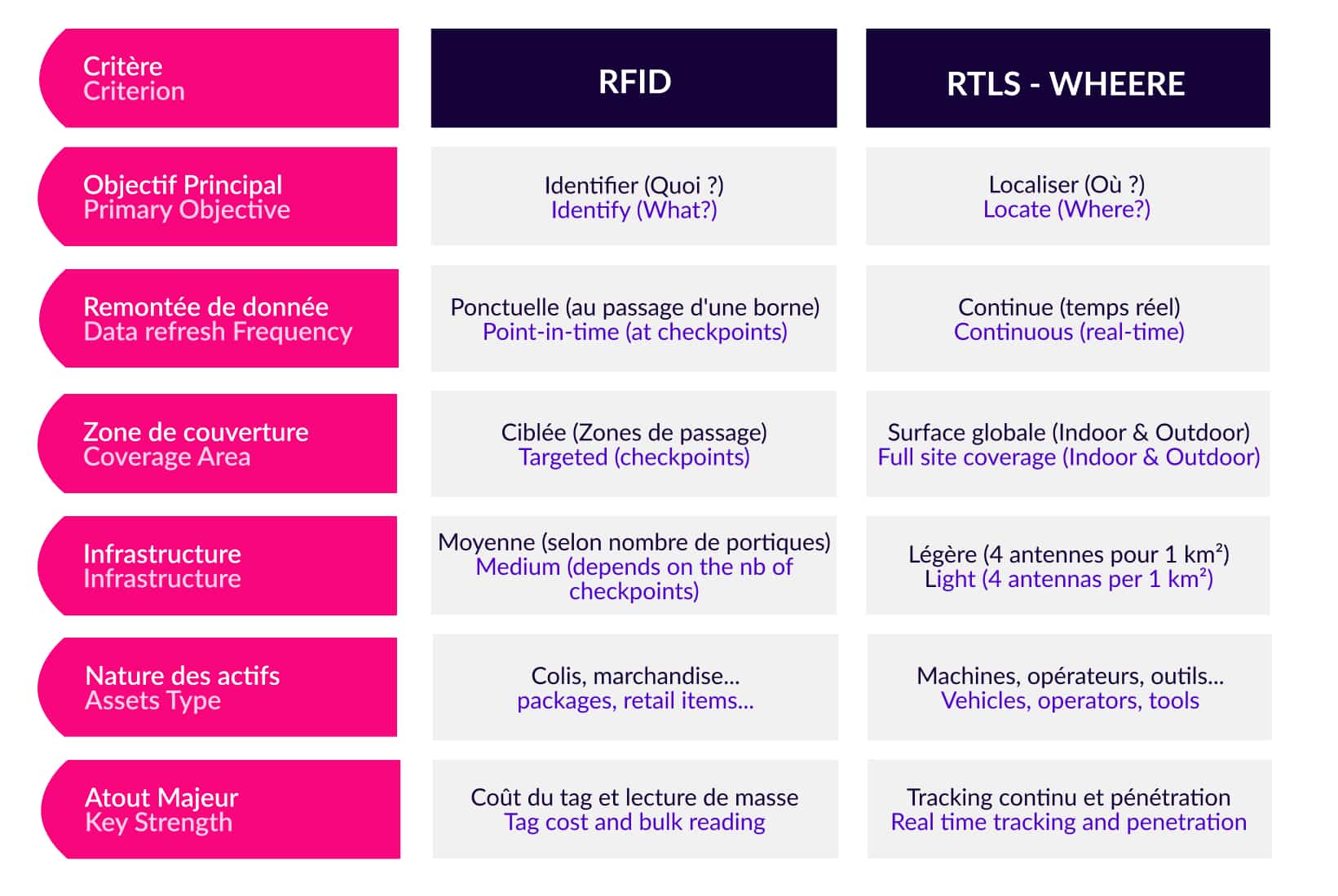
The final decision does not depend on the technology’s raw performance, but on how you will use location data on a daily basis.
Your top priority isinventory accuracy andlogistics automation. Whether you need to scan thousands of items upon receipt, verify that the right pallet is loaded onto the right truck, or conduct spot checks without human error, RFID is the most mature and cost-effective solution on the market.
Your top priorities areoptimizing workflow and ensuring safety. Whether you need to reduce the time spent locating equipment, analyze bottlenecks in your production (WIP), implement geofencing to protect your employees, or ensure full traceability across large areas without expanding your network infrastructure,
Share it and discover other articles you might also like!