

By definition, a Real-Time Location System (RTLS) (Real-Time Location System) is an intelligent network infrastructure designed for the identification, tracking, and dynamic management of assets or people flows.
Unlike GPS, which is designed for open spaces, RTLS is optimized for complex environments: warehouses with steel structures, densely packed factories, or mixed-use industrial sites.
Most RTLS systems are based on a four-component architecture:
Tags: Devices attached to people and/or assets. They support radio protocols (UWB, BLE, etc.) and manage their power consumption using built-in accelerometers so that they transmit only when movement is detected.
Anchors: Fixed reference points that capture signals emitted by tags. The system’s accuracy depends on the ability of these anchors to time-stamp messages to the nanosecond to counter the effects of multipath (reflections off metal).
The Calculation Engine (Location Engine): The algorithmic brain that processes raw data (Time of Flight, TDOA, etc.) to generate X, Y, and Z coordinates.
The Application Platform (Middleware): The interface that transforms raw data into business intelligence: geofencing alerts, productivity dashboards, and digital twins.

In the rapidly evolving world of manufacturing and logistics, location data has become the new nervous system of smart factories and connected warehouses. Yet behind the acronym RTLS lies a fragmented technological landscape: there is no single solution, but rather a myriad of solutions capable of serving as the foundation for a real-time tracking system.
For technical decision-makers, the equation is complex. Choosing a technology means balancing often conflicting factors: accuracy versus coverage, energy efficiency versus signal latency, or deployment agility versus infrastructure density.
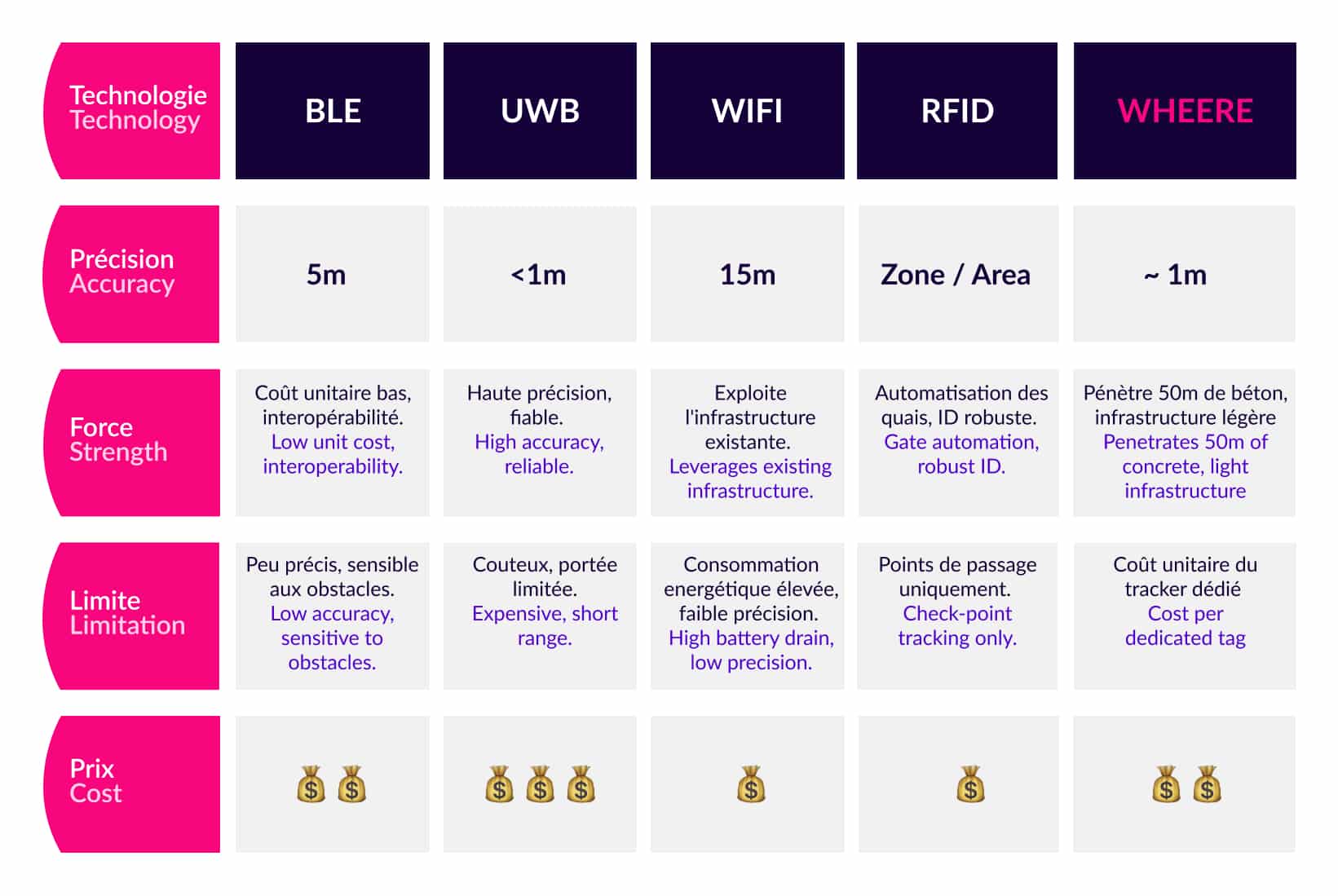
Here is our analysis of thesix main technologies available on the market:
Bluetooth Low Energy operates in the 2.4 GHz frequency band. Originally designed for short-range communication between consumer devices, it has established itself as a location tracking tool in the industrial sector thanks to its extremely low power consumption and native interoperability with fleets of mobile devices.
Its main advantage lies in its mature ecosystem and highly competitive unit cost. However, its historical performance, which relies on signal strength (RSSI), makes it structurally sensitive to environmental variations, such as the presence of obstacles or metal reflections. While the introduction of Angle of Arrival (AoA) positioning improves accuracy, BLE remains a solution suited to low-density environments but shows its limitations in large production workshops saturated with radio equipment or metal objects.
TheUltra-Wideband uses a wide frequency spectrum to transmit radio pulses lasting one nanosecond. By calculating the time of flight (ToF) of these pulses, the system achieves an accuracy often less than 30 centimeters.
This makes it the technology of choice for critical applications, such as vehicle-pedestrian collision avoidance. However, UWB waves do not penetrate physical obstacles well. To maintain accuracy, a beacon must be installed every 20 meters, which increases installation costs and limits the use of this technology to the most strategic areas.
Wi-Fi RTLS uses network access points already deployed in buildings to locate connected assets. It typically relies on trilateration algorithms based on the signal strength detected by surrounding access points.
The immediate advantage is reduced initial investment (CAPEX), since part of the infrastructure is already in place. It is a practical solution for tracking IT equipment, scanners, or carts already equipped with Wi-Fi cards. However, accuracy remains low, and the tags’ power consumption is significantly higher than that of Bluetooth or UWB. Wi-Fi is therefore ideal for “zone-based” location tracking of assets that can be recharged frequently, but is less suitable for granular tracking of people or tools.
Unlike its passive counterpart, active RFID uses battery-powered tags that autonomously transmit their identifiers to dedicated readers. It is primarily used to confirm the presence of an object within a defined perimeter around a detection gate.
Its strength lies in its robustness and reliability during rapid passages, making it the perfect tool for automating loading docks or conducting proximity inventories in warehouses. It offers excellent resistance to harsh industrial environments. However, it is not designed to provide a smooth trajectory or perform tracking. It functions more like a series of digital barriers, limiting its usefulness for optimizing picking routes or analyzing production flows.
LoRa technology, based on interference-resistant modulation, was designed to transmit small amounts of data over distances of up to several kilometers. For location tracking, it generally uses time difference of arrival (TDOA).
It offers record-breaking battery life and unmatched range. Its major drawback, however, lies in its accuracy—which often ranges between 50 and 100 meters in real-world conditions—and its high latency. It is therefore ideal for determining whether a container is present in a 10-hectare yard, but completely unsuitable for precisely locating a package on a shelf or managing production flows in real time.
Wheere has overcome a technological hurdle long considered insurmountable: reconciling indoor coverage with location accuracy. This patented geolocation system relies on unmodulated low-frequency (VHF) radio signals capable of penetrating up to 50 meters of concrete. Only 4 antennas are needed to cover 1 km² of industrial space.
The antennas transmit the signals, and the receiver (tracker) calculates its own position. Since there is no return signal from the tag to the anchors, the network never becomes overloaded, making it possible to track a virtually unlimited number of objects or people simultaneously. The system provides three-dimensional (X, Y, Z) accuracy to the nearest meter with an adjustable refresh rate, ranging from two positions per second to once per day, depending on the specific use case.
For experts in the industrial and logistics sectors, RTLS is not merely a tracking technology, but a tool for optimizing TCO (Total Cost of Ownership) and enhancing process security. Here are a few examples of how an RTLS system can be used:
ON THE SAME TOPIC
A real-time location system (RTLS)offers numerous benefits to industry and logistics professionals.
Here are the four key benefits that transform operational performance:
By connecting the physical flow to the digital flow, we optimize visibility.
RTLS enables the automated collection of data without human intervention (without scanning).
RTLS enables both preventive and corrective measures to be taken to ensure employee safety.
Beyond logistics, RTLS has a direct impact on the company’s bottom line.
“The true value of RTLS lies in its ability to eliminate blind spots in the supply chain. Every minute saved on searching, every bottleneck identified, and every route optimized directly impacts profitability.” — Pierre Bolzonello, Sales Director at Wheere.
Installing a real-time location system (RTLS) in a factory or warehouse is an engineering challenge that goes far beyond simply installing sensors. In industrial environments, real-world conditions sometimes contradict the theoretical promises made in the laboratory.
Here are the five major challenges experts face during deployment:
Industrial sites are filled with metal structures (racks, machinery, mezzanines) and concrete walls.
• The multipath effect: Radio signals bounce off metal surfaces, creating echoes that mislead the calculation engine about the tag’s actual position.
• Attenuation: High frequencies (such as 6 GHz UWB or 2.4 GHz Bluetooth) are easily blocked or absorbed by physical obstacles, creating “dead zones.”
To cover large areas with meter-level accuracy, conventional systems (UWB, BLE) require a very dense network.
• Anchor density: Having to install an antenna every 20 meters is a massive undertaking.
• Cabling and power supply: Each anchor must be powered (often via PoE – Power over Ethernet). In a 20,000 m² factory, the cost of cabling and installation can sometimes exceed the cost of the RTLS hardware itself.
• Maintenance: The more anchors there are, the higher the risk of a network component failure.
Industrial environments are already saturated with wireless signals: Wi-Fi for devices, Bluetooth for connected tools, private 4G/5G networks, and electromagnetic noise generated by motors and welding stations.
• Coexistence: A poorly designed RTLS system can interfere with the factory’s critical Wi-Fi or, conversely, see its performance plummet due to surrounding interference.
An “X, Y, Z” coordinate has no business value in and of itself. The challenge is to transform these location coordinates into a logistics event that can be understood by an ERP or WMS.
• Interoperability: Connecting the RTLS to existing systems (SAP, Oracle, etc.) requires robust middleware capable of filtering out position “noise” (unwanted position jumps) to report only actual and relevant movements.
Deploying thousands of trackers raises critical logistical questions:
• Battery life: A system that requires tags to be recharged too frequently is doomed to operational failure. The expert must balance refresh frequency against battery life.
• Ergonomics and durability: Tags must be shock-resistant, dust-resistant (IP67), and sometimes adapted to the constraints of explosive environments (ATEX standards).
Faced with these engineering challenges, Wheere offers a disruptive solution that radically simplifies the deployment process.
By utilizing very high frequency (VHF), our technology overcomes traditional physical barriers: where the signal weakens, Wheere penetrates up to 50 meters of concrete, effectively eliminating dead zones without increasing the number of access points.
This breakthrough allows us to move from complex cabling projects to an ultra-lightweight infrastructure capable of covering 1 km² with just 4 antennas.
Finally, by opting for a “broadcast” mode without signal feedback to the anchors, we eliminate the bottleneck of network saturation, enabling the tracking of an unlimited number of assets with consistent reliability.
Wheere makes RTLSscalable, resilient, and accessible to the most demanding industrial environments.
The duration depends directly on the technology chosen. For solutions such as UWB or BLE, installation takes between 2 and 8 weeks, depending on the area to be covered, due to the dense cabling (one anchor every 20 meters). Wheere reduces the installation phase to just a few days, since it requires only 4 antennas to cover an area of 1 km².
The overall budget depends directly on the characteristics of your site (area, architectural complexity, presence of metal structures) and the technology selected.
To calculate the actual cost of the project, it is necessary to analyze the total cost of ownership (TCO), including:
Installation and cabling: These costs are often very high with traditional technologies, which require a dense network of anchors powered by network cables (PoE).
Maintenance: monitoring the fleet, replacing tag batteries, and managing the network of anchors over time.
The raw coordinates (X, Y, Z) generated by the calculation engine are filtered and processed by middleware. The middleware communicates with your business applications (SAP, Oracle, custom WMS) via standard APIs (REST, MQTT, Webhooks) to transform raw positions into logistics events (e.g., “Pallet X entered Zone B”).
Battery life ranges from 2 to 10 years, depending on the radio technology, battery size, and refresh rate. To maximize battery life, the tags are equipped with accelerometers: they enter deep sleep mode as soon as the object is stationary and transmit only when movement is detected or at spaced intervals during periods of inactivity.
Yes. There are ruggedized enclosures certified to IP67 or IP68 standards (resistant to water, dust, and industrial impacts). For chemical, petrochemical, or explosion-hazard sites, ATEX-certified tags are specially designed to comply with applicable safety standards.
Share it and discover other articles you might also like!
