

Private 5G marks the end of the compromise between mobility and reliability.
With a latency of less than 10 ms, guaranteed Quality of Service (QoS) and a high density of simultaneous connections, it offers performance equivalent to that of a wired network, without the constraints of cabling.
This makes it possible to connect HD cameras, IoT sensors, control systems, AGVs or robots without deploying kilometers of fiber, while guaranteeing the stability of critical flows.
The result: more flexible installations, faster deployments and a leaner infrastructure, adapted to the evolving needs of modern industry.
Private 5G erases the historical boundary between IT (data, cloud, supervision) and OT (machines, sensors, automation) systems.
Thanks to stream prioritization, edge computing and end-to-end security, information flows freely between the field and decision-making systems.
Equipment data can be used in real time for predictive maintenance, supervision andprocess optimization.
Architectures are unified, and industrial data becomes a real lever for performance and agility.
Geolocation is becoming an essential lever for optimizing flows, tracking assets and reinforcing safety on industrial sites.
Designed for these complex environments, Wheere offers continuous, sub-meter precision, indoors and out, without white zones or signal loss, even through 50 meters of concrete.
Integrated with private 5G, it takes advantage of its low latency, connection density and local edge computing processing to transmit positions in real time and guarantee data sovereignty.
This complementarity enables precise, reliable monitoring, adapted to industrial requirements.
Among its applications, geofencing can be used to define virtual zones (safety, maintenance, production) and automatically trigger alerts, notifications or machine stoppages depending on the extent to which they are crossed.
A tangible asset for securing operations and smoothing flows in the field.
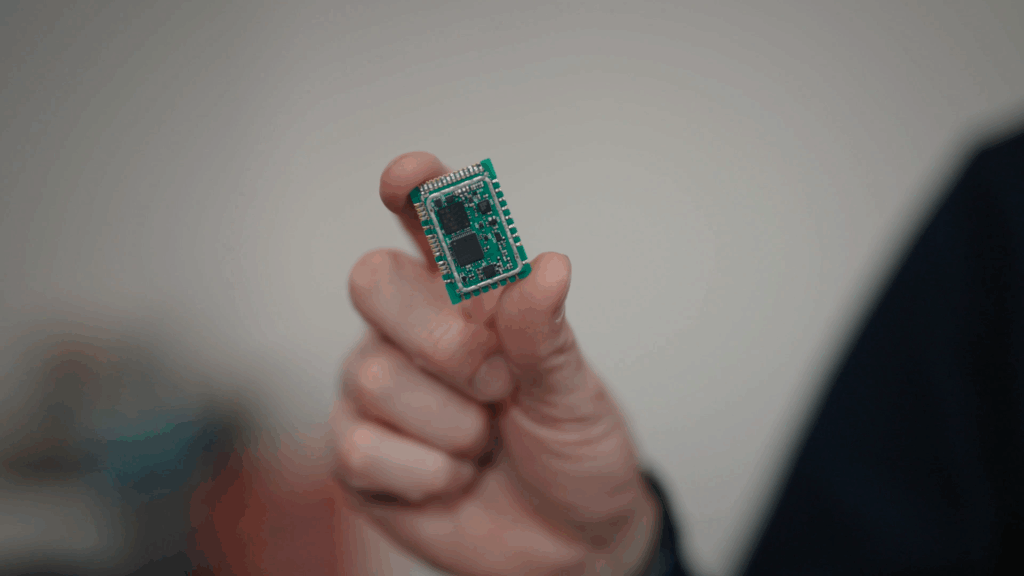
Private 5G enables industrial companies to retain full control over their data and network infrastructure.
Hosted locally, it guarantees that critical production, maintenance, geolocation or supervision information never leaves the site, ensuring confidentiality, traceability and continuity of service.
Each terminal connected to the network is identified by a physical SIM card, making any external connection impossible without authorization.
In the event of an anomaly or attack, the administrator can immediately isolate a compromised terminal without disrupting other flows, thus avoiding any risk of propagation.
This architecture strengthens network resilience and enables us to offer sovereign, secure solutions that meet the requirements of environments where data is a strategic issue.
Private 5G is the first network technology capable of offering continuous, stable connectivity in highly mobile industrial environments.
Thanks to transparent handover, equipment such as autonomous vehicles, robots and connected operators can move from one zone to another without signal loss or perceptible latency.
This continuity paves the way for new uses, such as AGV coordination, real-time video inspection, remote machine control and simultaneous tracking of indoor and outdoor flows.
Coupled with Wheere, this mobility becomes measurable: each asset or operator is precisely located, enablingtravel to be analyzed,routes optimized andoperational safety improved.
It's not just about better connectivity: it's about controlling operations,integrating systems, and securing data as close to the field as possible.
The five levers presented in this article - high-performance wireless connectivity, IT/OT convergence, precise geolocation, local security and real-time mobility - outline the contours of a unified, intelligent industrial infrastructure.
This evolution is no longer a technological promise: it's already underway, driven by players like Wheere, who are helping to transform the private 5G network into a genuine operational platform.
For integrators and manufacturers alike, the challenge is no longer to connect equipment, but tointelligently orchestrate flows and decisions in an ecosystem that is now interconnected, responsive and under control.
Share it and discover other articles you might also like!
