

Today, the safety of isolated workers is a regulatory and operational imperative for employers. It's no coincidence that the market for connected solutions for the protection of isolated workers (PTI) is growing rapidly. According to the Berg Insight study (2024), there were 2.3 million lone workers equipped in Europe, North America and Oceania. In Europe, the market value of connected PTI solutions is estimated at 180 million euros.
Employers are multiplying their initiatives: equipment, training, protocols. But one subject remains a particular stumbling block in the field: indoor geolocation.
The legal framework is clear: whether working outdoors or inside a building, employers are responsible for the safety of lone workers. This implies, among other things, the ability to quickly and accurately locate an employee in a critical situation, whatever their position on site.
In complex industrial environments (factories, warehouses, tunnels, basements...), conventional geolocation technologies (GPS, 4G/5G, Wi-Fi...) quickly show their limitations. The signal disappears, locations are imprecise, and white zones persist.
It's not a question of willpower, but of physics.
The most widespread geolocation technologies are based on high-frequency radio waves. These short, fast waves work very well outdoors. But as soon as they encounter physical obstacles (concrete, metal, thick walls...), they are reflected, absorbed or diffracted. As a result, they no longer reach the receiver, making location impossible or inaccurate.
This is exactly what happens indoors: buildings, workshops or industrial facilities act as natural barriers to GPS or cellular signals. Hence the difficulty of reliable indoor positioning.

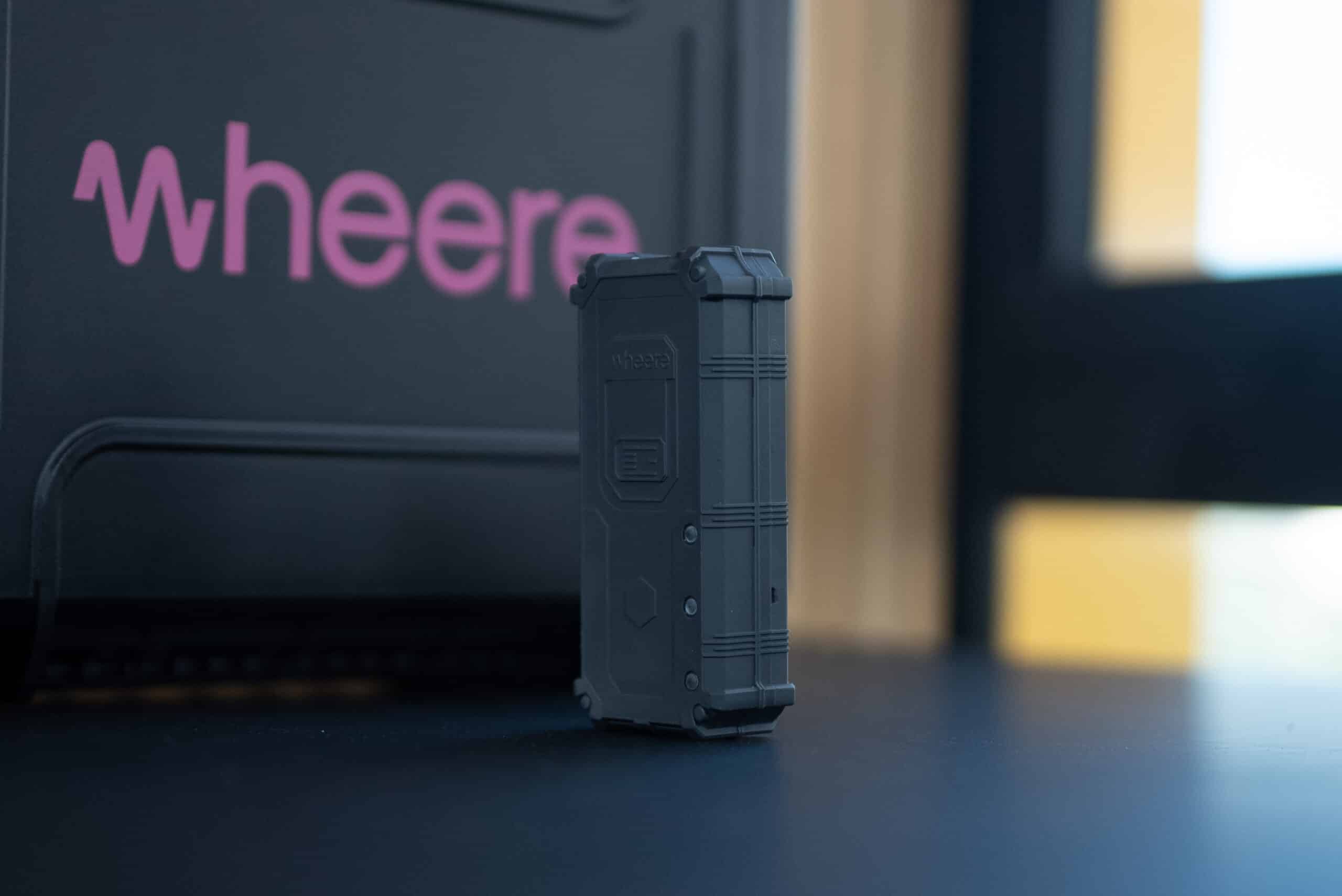
To meet this challenge, Wheere has developed a patented low-frequency geolocation technology designed specifically for indoor use.
Unlike traditional solutions, Wheere uses VHF (low frequency) radio waves, capable of penetrating up to 50 meters of concrete. Combined with an intelligent algorithm, this technologyisolates the signal's direct trajectory, ignoring the multipath effects common in enclosed environments.
Precise location to within 1 meter, even in complex industrial environments
Complete indoor and outdoor coverage, without dense infrastructure
Stand-alone operation, not dependent on GPS or 4G/5G
On a Wheere-equipped industrial site, just four antennas are enough to cover the entire perimeter, indoors or outdoors. It doesn't matter whether the agent is in an underground technical room, a metal workshop or a logistics warehouse, he can be located in real time.
For HSE or safety managers, this means :
Immediate removal of doubt in the event of an alert
A critical time-saver for interventions
Enhanced traceability of incidents
Share it and discover other articles you might also like!
